


Verstappen wins after Leclerc’s unforced error leaves F1 title bid in tatters after French Grand Prix.
After the most erratic start to a season, Ferrari looked prime to pull out of their self induced skid after back to back wins in Great Britain and Austria even after it felt like the season long title had gone up in smoke with their multiple engine failures.
Ferrari was once again on the pole for the race and they had the pace to win.
Right up until Charles LeClerc ran straight into a wall emitting a scream so loud, you could here the anguish around the world.
With LeClerc out of the way, the race was Red Bull Racing Max Verstappen’s to lose as he and LeClerc where drastically faster than everyone else.
What made it so difficult to bear was that this moment was on LeClerc. On a weekend when his Ferrari looked like a match for Red Bull and was looking on course for victory, he made an unforced error.
“It was just a mistake," LeClerc said in a race interview. “I tried to take too much around the outside and probably put a wheel somewhere dirty. It’s my fault, and if I keep doing mistakes like this, then I deserve to not win the championship. The level is very high this year, I’ve been performing at a high level, but if I keep doing these mistakes, then it’s pointless to be at a high level."
Hard to argue with that assessment. His mistake now means Leclerc is now 63 points back of Max Verstappen in the championship with 10 races remaining. Had he not made the mistake and gone on to win the race, he would have cut the gap to the reigning champion to 31 points and successfully deprived Verstappen of a victory for the third consecutive race in a row. The accident felt like a pivotal moment in Leclerc’s title campaign.
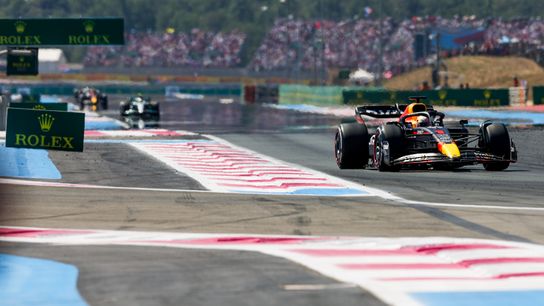
LE CASTELLET, FRANCE - JULY 24: Max Verstappen of Red Bull Racing and The Netherlands during the F1 Grand Prix of France at Circuit Paul Ricard on July 24, 2022 in Le Castellet, France. (Photo by Peter Fox/Getty Images) // Getty Images / Red Bull Content Pool // SI202207241035 // Usage for editorial use only //
He said: “I thought he would be faster. I thought it would be very hard to follow [Leclerc], but immediately I could see that our balance was not bad,” continued Verstappen. “It looked like we were very competitive and that is of course what we like to see.
The opening laps of the French Grand Prix were tense as Verstappen’s Red Bull stalked the rear of Leclerc’s Ferrari. Initially it seemed like a matter of time before Verstappen made use of his Red Bull’s superior straight-line speed and steamed past Leclerc with the help of his car’s Drag Reduction System (DRS), but the Ferrari driver was fast in all the right places to hold off the reigning world champion.
The battle was made all the more exciting by the setup decisions of the two teams earlier in the weekend. Ferrari had opted for a high downforce setup, resulting in high cornering speeds but a deficit on the straights, while Red Bull had prioritised straight-line speed over cornering performance with a low-drag setup.
In theory, Verstappen should be able to breeze past the Ferrari on the Mistral Straight, but Leclerc’s speed through Turns 5 and 6 beforehand meant the Red Bull was never quite close enough to get the job done. After several failed attempts, Red Bull looked to take the lead through the pit stops and called Verstappen in for fresh tyres on lap 16 — much earlier than anyone had predicted for a one-stop strategy.
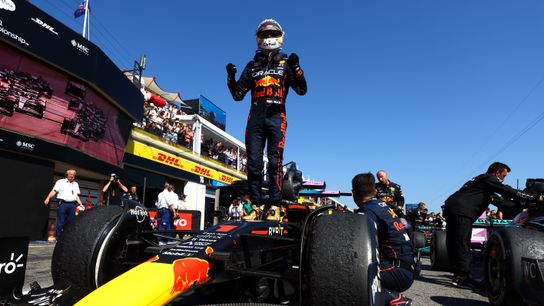
LE CASTELLET, FRANCE - JULY 24: Race winner Max Verstappen of the Netherlands and Oracle Red Bull Racing celebrates in parc ferme during the F1 Grand Prix of France at Circuit Paul Ricard on July 24, 2022 in Le Castellet, France. (Photo by Mark Thompson/Getty Images) // Getty Images / Red Bull Content Pool // SI202207240827 // Usage for editorial use only //
Had the plan worked, it would have given Verstappen the lead of the race but come at the cost of a tyre disadvantage, as Leclerc would have emerged from the pits on tires several laps fresher than the Red Bull’s — an advantage he would have taken to the end of the race and tried to exploit with an on-track pass for victory.
Red Bull team boss Christian Horner acknowledged it was an aggressive strategy but was optimistic Verstappen would have been able to hold on for the win.
“It was interesting because Max was able to stay close to Charles for a long period of time in the first stint without the tires getting stratospherically hot," Horner said after the race. “We were — as we’d seen the rest of the weekend — very quick in sector two [on the straights], similar to Ferrari in sector one and bit slower in sector three — mainly Turn 11.
“The race was going OK and we were in his DRS, but we couldn’t get close enough in Turn 6 ahead of the straight to really capitalize on the DRS. So that’s why we banked the track position, and I think we would have been able to defend reasonably comfortably with the speed we had in sector two. It was very close between the two teams even though we had a very different approach to achieving the lap time."Once Leclerc had spun out of contention, Verstappen was able to ease off knowing that Lewis Hamilton’s much-slower Mercedes was never really going to be a threat for the victory. As a result, we’ll never know how much his tires would have suffered by the end of the race had he been put under real pressure by Leclerc.
What will hurt most for Leclerc is the knowledge that his Ferrari is capable of challenging for the title this year. Championship-worthy cars are hard to come by in F1, and the majority of drivers will go their whole career without ever getting a shot at the title. Such opportunities need to be taken, but Leclerc can feel this one slipping through his fingers after just 12 of 22 races.
After Sunday’s result, even the best possible points swing in Hungary next weekend (with him winning and Verstappen failing to score) would only bring him back to his pre-France long-shot status — only with two fewer races to close the gap. More likely, Ferrari and Leclerc will go into F1’s summer break staring at a gap of over 50 points and wondering where it all went wrong.
If they are honest with themselves, they will uncover a long list of errors that has been steadily growing for the past nine races. Since the Australian Grand Prix in March, which Leclerc won to extend his championship lead to 36 points, he has conceded 107 points to Verstappen — an average of nearly 12 points per race.
A swing of roughly 72 points in Verstappen’s favour can be attributed to a combination of reliability issues, strategy errors and grid penalties for Leclerc at the Spanish, Monaco, Azerbaijan, Canadian and British Grands Prix, but an exact figure of 32 can be traced to Leclerc himself.
He can only hope that the title does not come down to 32 points at the end of the season.
What’s next?
The 2022 Hungarian Grand Prix takes place next weekend on July 29-31 to cap off this double-header – with Leclerc staring down a deficit of 63 points to Verstappen and Ferrari seeking to reduce Red Bull’s 82-point lead.