


Robin Goomes arrived at Red Bull Rampage with two consecutive victories, a reputation as one of the world's most progressive freeride mountain bikers and the considerable pressure of trying to accomplish something nobody in the event's 25-year history had managed. By Thursday afternoon, the New Zealander had added another milestone to her growing legacy, delivering a spectacular second run to win the women's competition for the third consecutive year.
Goomes scored 93.50 points on her final run, overtaking American Hannah Bergemann, who had led after the opening round and ultimately finished second with 92.75. Canada's Kirsten Van Horne completed the podium with 86.50 points, capping a competition that brought 10 riders to the original Rampage venue near Virgin, Utah, and produced one of the closest finishes in the women's event's young history.
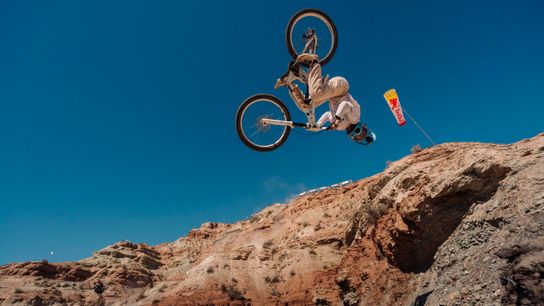
The victory made Goomes the first athlete, male or female, to win three consecutive Red Bull Rampage titles. More significantly for the progression of women's freeride, she accomplished it by raising the technical difficulty of her riding rather than relying on the same approach that had already brought her success in 2024 and 2025. Her winning run featured a flat-spin 360, a backflip off a massive step-down and a backflip cancan near the bottom of the course, combining high-consequence tricks with the demands of descending an exposed Utah mountainside.
A Championship Decided on the Final Runs
For much of Thursday's competition, Bergemann appeared capable of ending Goomes' winning streak. The American delivered a confident opening run featuring a backflip near the top of the course, a technical chute, a substantial drop and a suicide no-hander at the finish. Her 91.25-point score established the early benchmark, putting her ahead of Goomes, who earned 90.62 on her first attempt.
That left Goomes facing a familiar but difficult Rampage decision. With only two competition runs available, she needed to increase her score without making a mistake on terrain where the consequences of a failed trick or missed line can be substantial. Rather than simply repeat her opening descent, she increased the speed and execution of her second run while adding further technical difficulty, including the backflip cancan that helped distinguish her final performance.
The judges awarded Goomes 93.50 points, moving her ahead of Bergemann and placing the pressure squarely on the American's final attempt. Bergemann responded with another committed run, cleaning up sections of her line and improving her score to 92.75. The improvement was substantial, but it left her just three-quarters of a point short of victory, giving Goomes the narrowest winning margin of the three women's Rampage competitions held to date.
The final scores reflected how closely matched the two leading riders had become. Bergemann demonstrated the speed, control and technical riding necessary to challenge the defending champion, while Goomes found enough additional difficulty and execution to remain ahead. The difference was less about one rider dominating the mountain and more about two athletes pushing their performances until the competition was decided by the smallest of margins.
Red Bull Content Pool
Goomes Raises the Technical Standard Again
Goomes' third victory carries significance beyond the number of trophies she has accumulated. Since women's competition was introduced at Red Bull Rampage in 2024, she has won every edition, but each victory has required her to adapt to a field that continues to expand its technical abilities and willingness to attempt increasingly demanding lines.
Her preparation for 2026 reflected that approach. Back home in New Zealand, Goomes built a training drop specifically to practice the step-down backflip she intended to bring to Rampage. The trick required committing to a backward rotation while dropping from an elevated takeoff onto a landing well below, making preparation and consistency essential before attempting it in competition.
She also introduced a flat-spin 360 on an upper jump, a trick that had not previously been completed in the women's Rampage competition. The maneuver earned her the event's Utah Sports Commission Best Trick Award, while her overall performance also secured the People's Choice Award.
For Goomes, the progression was intentional. Speaking after her victory, she explained that repeating the achievement would require something more than the performances that had brought her the first two titles.
"All I knew this year is that if I wanted to do it again, I'd have to push harder than I've ever done and be better than I have been previously." Adrex.com
That mentality has become an important part of her success. Rampage rewards riders for the difficulty and creativity of their lines, the execution of individual tricks and the overall impression of their descents. Simply repeating a previously successful run is no guarantee of another victory, particularly as competitors arrive each year with new features, larger jumps and more ambitious combinations.
Bergemann Shows How Close the Competition Has Become
Although Goomes claimed the victory, Bergemann's performance provided one of the strongest indications of how quickly women's freeride is progressing. Her second-place finish was her second consecutive Rampage runner-up result, and her 92.75-point final run brought her within less than one point of defeating a rider who has never lost the women's competition.
Bergemann's riding emphasized a combination of speed, technical control and commitment on the natural terrain. Her line included exposed sections and significant drops, requiring her to maintain momentum through difficult features rather than relying exclusively on tricks performed on constructed jumps. That balance has become increasingly important as the women's field develops different approaches to competing at Rampage.
The American also received the BFGoodrich Tires Toughness Award, recognizing her performance during a demanding week of preparation and competition. Her result reinforced the idea that Goomes' continued success is taking place against increasingly capable opposition, not in the absence of serious challengers.
Van Horne added another dimension to the podium with a controlled first run that earned 86.50 points. The Canadian combined technical riding with tricks that included a toboggan, a tuck no-hander and an Indian air, choosing a line that emphasized execution and flow through the mountain's exposed terrain. She elected not to make a second attempt, leaving her opening score sufficient to secure third place.
Behind the podium, New Zealand's Vinny Armstrong finished fourth with 82.75 points, followed by Australia's Harriet Burbidge-Smith with 82.51. Chelsea Kimball, Mikayla Parton, Georgia Astle, Casey Brown and Janelle Soukup completed the 10-rider field, each contributing to an event that demonstrated the range of styles and approaches now emerging in women's big-mountain freeride.
Twenty-Five Years Later, Rampage Returns to Where It Began
The setting made Thursday's competition particularly meaningful. Red Bull Rampage returned to its original venue near Virgin, Utah, as part of its 25th anniversary, bringing the event back to the terrain where it first began in 2001. The return connected the modern competition to the early years of freeride, when riders helped establish the discipline through creative line selection, technical descents and a willingness to tackle terrain that had rarely been considered suitable for competitive mountain biking.
The 2026 course incorporated portions of the original mountain alongside a new upper section, creating the tallest Rampage venue to date. The additional elevation and expanded terrain increased the demands placed on riders and their digging crews, who spent days constructing and refining the lines they would ultimately attempt in competition.
This year's event also introduced a significant milestone in how the men's and women's competitions share the mountain. For the first time, both fields used the same starting gate, with some sections of their lines overlapping. While riders continued to develop individual routes suited to their abilities and competitive goals, the shared starting point represented another step in the integration of women's freeride into the event's established structure.
That distinction matters because Rampage is fundamentally different from a conventional downhill race or slopestyle competition. Riders and their crews are responsible for developing much of their own route down the mountain, choosing how to connect natural terrain with constructed features. The resulting runs are not identical, and the judging process must evaluate different combinations of difficulty, execution, amplitude and style.
As the women's competition enters its third year, the progression is becoming visible not only in the tricks riders are attempting but also in the complexity of the lines they are willing to build and ride. Goomes' winning run offered one example of that evolution, while Bergemann's aggressive approach and Van Horne's technical precision demonstrated that there is more than one way to produce a competitive Rampage performance.
Three Wins, but No Signs of Standing Still
Three consecutive victories would be enough to establish almost any athlete as the defining competitor of an event. Goomes has accomplished that in the first three years of women's Red Bull Rampage, but the narrow margin of Thursday's result suggests maintaining that position will become increasingly difficult.
Bergemann was within 0.75 points of the victory, Van Horne delivered another podium performance, and the broader field continued to introduce tricks and lines that would have been considered major milestones only a few seasons ago. The progression of women's freeride is no longer represented by a single athlete or a single groundbreaking trick; it is increasingly reflected in the depth of the competition and the expectation that riders will continue pushing the sport forward.
For Goomes, Thursday provided both a historic achievement and confirmation that the standard required to win is still rising. She returned to Utah with two Rampage titles and the knowledge that repeating her previous performances might not be enough. By the end of the competition, she had delivered the highest-scoring run of the day, added another major trick to women's freeride history and secured a third consecutive victory.
Twenty-five years after Rampage first began reshaping what was possible on a mountain bike, its women's competition is helping write the next chapter. Goomes remains the rider everyone is chasing, but Thursday's final made one thing clear: the distance between the defending champion and her challengers is getting smaller.