


Miami gave Formula 1 exactly what it promises every year: celebrities, chaos, weather drama, big swings, bright lights and a race weekend that felt more like a full-blown spectacle than a traditional Grand Prix.
But beneath the South Florida gloss, the story of the 2026 Miami Grand Prix was simple.
Kimi Antonelli is no longer coming.
He is already here.
The 19-year-old Mercedes driver continued his remarkable early-season rise Sunday by winning the Miami Grand Prix, holding off McLaren’s Lando Norris to claim his third consecutive Formula 1 victory and stretch his championship lead. It was another statement drive from the Italian, who is quickly turning potential into proof and hype into hardware.
Antonelli crossed the line 3.264 seconds ahead of Norris, with Oscar Piastri completing the podium for McLaren after a late-race move on Ferrari’s Charles Leclerc. George Russell finished fourth for Mercedes, while Max Verstappen recovered from an early spin to take fifth for Red Bull.
The result gave Mercedes another major victory in a season that is beginning to feel increasingly shaped by Antonelli’s rapid arrival at the front of Formula 1.
“It is just the beginning, the road is still long,” Antonelli said after the win. “The team is doing an incredible job.”
That may be the measured language of a driver trying to stay grounded, but the numbers are becoming impossible to ignore. Antonelli has now converted his first three career Formula 1 wins from pole position, a remarkable run for any driver, let alone a teenager still early in his rookie campaign.
Mercedes team principal Toto Wolff summed up the performance over the radio with unusual restraint for a team boss known to demand perfection.
“Kimi, that was very, very impressive,” Wolff told him. “There was nothing to complain about today.”
Tyler Tate via AP
That was not entirely true for the rest of the field.
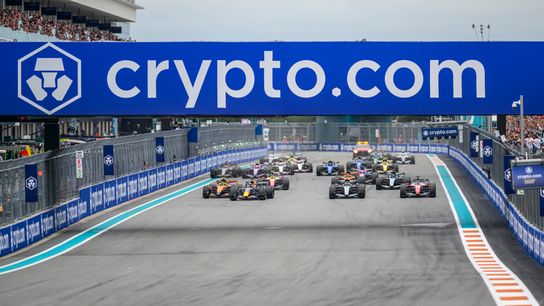
Miami’s main event started with the threat of weather, a schedule change and enough early-race madness to make the first handful of laps feel like a sprint all their own. Formula 1 moved the Grand Prix start forward because of concerns over lightning and thunderstorms, and while the rain stayed away once the race began, the track and conditions still helped create a frantic opening phase.
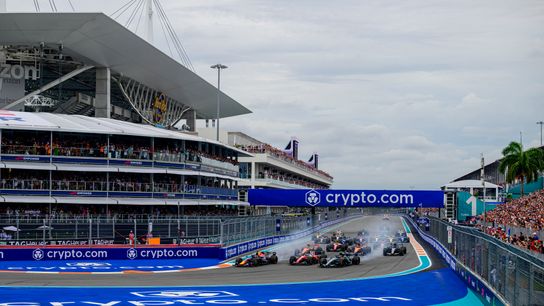
Antonelli started from pole, but his launch was far from clean. Charles Leclerc attacked immediately from third, Max Verstappen was involved in the fight from the front row, and the opening corner quickly became a pressure point for three drivers all trying to own the same piece of asphalt.
Leclerc briefly surged into the lead, Antonelli ran wide, and Verstappen spun after contact while trying to stay in the fight. The Red Bull driver dropped down the order and was left to recover from a race that had unraveled almost before it had settled.
Then came more trouble.
Isack Hadjar’s race ended early after he went into the wall, and Pierre Gasly was involved in a frightening incident after contact with Liam Lawson, with Gasly’s car ending up in a dramatic position before he climbed out on his own. The safety car bunched the field and reset the race, giving the leaders another chance to attack.
That is when the Miami Grand Prix started to come alive.
Norris, who had already shown McLaren’s strength by winning Saturday’s Sprint, worked his way into the lead after the restart. For a stretch, it looked as if the reigning world champion had a serious shot to turn McLaren’s Sprint momentum into a full Grand Prix victory.
Instead, Miami became a strategy fight.
Norris had the pace. Antonelli had the timing.
The critical moment came in the pit cycle, when Mercedes brought Antonelli in before McLaren responded with Norris one lap later. That undercut proved decisive. When the stops shook out, Antonelli had track position, and in modern Formula 1, track position with clean pace can be everything.
Norris knew it immediately.
“How did we not win this?” he said over the radio after the checkered flag.
Later, Norris was more composed but still clearly frustrated.
“We just got undercut. No excuses other than that,” Norris said. “Hats off to Merc and Kimi. They drove a good race.”
Tyler Tate via AP
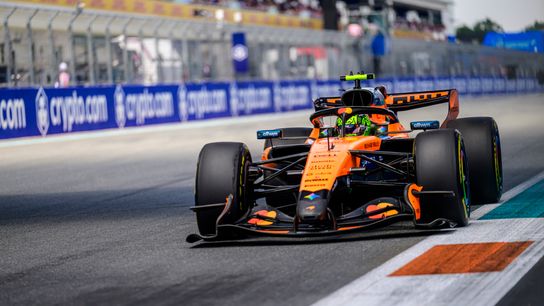
McLaren Mastercard F1 Team driver Lando Norris (1), of the United Kingdom, races down the front straight during the Sprint Race of the Formula 1 Crypto.com Miami Grand Prix auto race in Miami, Fla. Saturday, May 2, 2026.
For McLaren, the weekend was both encouraging and painful.
Saturday had belonged to papaya.
Norris started the Sprint from pole and controlled the 19-lap race from the front, leading Piastri home for a McLaren one-two. Leclerc took third for Ferrari, while Mercedes struggled more than expected. Antonelli, who started second, dropped back after another poor start and later fell to sixth after a track limits penalty. Russell finished fourth, Verstappen moved up to fifth after Antonelli’s penalty, and Lewis Hamilton was seventh for Ferrari.
It was a clean, confident Sprint from Norris, who looked fully in command as McLaren’s upgrades appeared to deliver exactly what the team had hoped. Piastri kept Leclerc behind to secure the one-two, and suddenly Miami looked like it might be the weekend McLaren fully pushed Mercedes back onto its heels.
For one day, it did.
Norris’ Sprint win ended Mercedes’ early-weekend control and proved McLaren had real race pace, not just qualifying flash. It also gave the Miami crowd a sharp reminder that the championship fight may not be as simple as Mercedes running away at the front.
But Sunday showed the difference between being fast and finishing the job.
Norris had the race in reach, but Mercedes executed when it mattered. Antonelli absorbed the pressure, survived the early chaos, recovered from the poor start and made the decisive stint count.
Piastri’s third-place finish gave McLaren another podium and softened the sting, especially after he snatched the position from Leclerc late. For much of the Grand Prix, Piastri did not look like a guaranteed podium finisher, but he stayed close enough to benefit when Ferrari’s race began to unravel.
“For a long part of that race, it definitely wasn’t looking like a podium,” Piastri said. “To end up in third is a really good result.”
Ferrari, meanwhile, left Miami with one of those weekends that looked promising, then slowly collapsed into frustration.
Leclerc had the launch of the race and briefly looked like he might turn his front-row-adjacent starting spot into something special. He led early, fought hard and stayed in podium contention deep into the Grand Prix. But the final laps were brutal. Piastri got by, Leclerc spun, then Russell and Verstappen also moved ahead.
A later penalty for repeatedly cutting corners in his damaged car dropped Leclerc farther down the order, turning what had looked like a likely podium into a painful result.
“I made a mistake that cost me several positions,” Leclerc said. “That’s on me.”
Hamilton finished behind the lead group on track but moved up after penalties were applied, continuing a Ferrari weekend that had flashes but not enough execution. The Scuderia showed speed at times, especially off the line, but Miami punished every rough edge.
Verstappen’s weekend was equally complicated.
Red Bull arrived in Miami looking for signs that its recent updates could help close the gap, and Verstappen’s front-row start suggested there was progress. But the race went sideways quickly with the opening-lap spin. From there, it became a recovery drive.
The reigning Red Bull force of recent seasons is not gone, but Miami made clear that the 2026 field is no longer operating around one predictable center. Verstappen still salvaged fifth, even after a post-race penalty for crossing the white line at pit exit, but this was not the kind of weekend that once made Red Bull look inevitable.
Mercedes looked sharper.
McLaren looked dangerous.
Ferrari looked fast but fragile.
Red Bull looked improved but still searching.
And Cadillac, making its first U.S. race appearance in Formula 1, had a difficult home weekend on track. Sergio Perez and Valtteri Bottas both finished, but well outside the points, leaving the American-backed effort with more work to do as it continues to build credibility in the sport.
Tyler Tate via AP
Still, Miami was not short on entertainment value.
The weekend had a little bit of everything. A McLaren Sprint statement. A Mercedes Sunday response. A teenage winner tightening his grip on the championship lead. A frustrated world champion wondering how victory slipped away. A Ferrari driver watching a podium vanish in the final moments. A Red Bull comeback drive that started with a spin and ended with damage limitation.
That is exactly the kind of layered weekend Formula 1 wants from Miami.
It was not just a race. It was a reminder that this season has already developed multiple storylines worth following.
Antonelli’s rise is the biggest one.
There is always risk in crowning a young driver too early, especially in a sport that can humble even its most talented prospects. But Antonelli is not merely showing flashes. He is stacking results. Pole positions. Wins. Composure under pressure. Recovery after mistakes. The ability to answer a Sprint disappointment with a Grand Prix victory less than 24 hours later.
That is not hype.
That is substance.
Norris and McLaren, however, made sure Miami did not feel like a coronation. Their Sprint performance was too strong, and their Sunday pace too real, to ignore. Norris may have left frustrated, but frustration over second place is usually a sign of rising expectations. McLaren believed it could win Sunday. Based on the race, it had every reason to believe that.
That could matter as the season heads toward its next phase.
If Mercedes has the best all-around package, McLaren may now have enough performance to make it uncomfortable. If Antonelli is the championship leader, Norris remains one of the drivers capable of dragging him into a proper fight. And if Piastri keeps collecting podiums on weekends when the car is not perfect, McLaren has a two-driver threat that could become increasingly difficult to manage.
Miami also showed that Sprint weekends can still reshape a narrative quickly.
Before Saturday, Mercedes looked like the team to beat. After Saturday, McLaren looked like it had arrived with a serious upgrade package and immediate answers. After Sunday, Mercedes had the trophy again, but McLaren had the proof that it can fight.
That tension is good for the sport.
The Miami Grand Prix has always leaned into spectacle, but this year the racing matched the setting. The Hard Rock Stadium campus gave Formula 1 its usual South Florida shine, but the track delivered substance beneath the show. There were strategy calls, wheel-to-wheel fights, safety car drama, penalties and a late podium swing.
In the end, though, the image that will last is Antonelli on top again.
Three straight wins.
A growing championship lead.
A Mercedes team that looks increasingly confident in its young star.
A 19-year-old driver trying to sound patient while his results are moving faster than anyone expected.
Miami did not just give Antonelli another victory.
It gave Formula 1 another reason to believe its next era may already be arriving.